

white logoburger
SUMMIT 2026HEIRS' PROPERTY

ABOUT

down arrow

POLICY

down arrow

RESEARCH & STORIES

down arrow

OUR SITES

down arrow
GET HELP
center header logo
SUMMIT 2026HEIRS' PROPERTY
Get Help
Group 2Created with Sketch.
Equitable Homeownership Blueprint
House background
Blueprint pillar titles

COMMUNITY EQUITY AND JUSTICE

STRONG, HEALTHY HOMES

FINANCIAL RESILIENCY

AGING IN PLACE

CLIMATE JUSTICE

1. Community Equity & Justice

VISION

New Yorkers have equitable access to homeownership regardless of race and ethnicity. Homeowners and their tenants live in neighborhoods free of blight, displacement, discrimination, and harassment from real estate speculators.

A sense of belonging, safety, and stability are critical elements of life that can only be fully realized at the community level. Unfortunately, our history of racial discrimination, disinvestment in communities of color, and predatory lending has led to unequal conditions in our neighborhoods today. The foreclosure crisis hit New York City's black and Latinx neighborhoods the hardest, resulting in thousands of families at risk of displacement as well as vacant and abandoned buildings. Meanwhile, home prices are increasing dramatically as an influx of new, wealthier, and generally white homebuyers and investors drives costs up, pricing long-time community members out of the opportunity to become homeowners in their neighborhood. Long-time community members face both physical and cultural displacement, and aggressive real estate solicitations can make people feel unwelcome or unsafe in their own neighborhoods. Conversely, neighborhoods built around inclusive community institutions and strong social connections enrich lives.
Equalizing homeownership rates would significantly reduce the racial wealth gap:
Wealth gap graphWhite$100,000$50,000BlackLatinx
Current
If homeownership was equal

If black and Latinx families were as likely as white families to own their homes, median black wealth would grow by $32,000 and the wealth gap between black and white households would shrink 31 percent.

Median Latinx wealth would grow by $29,000 and the wealth gap with white households would shrink 28 percent.

GOALS

  • Strengthen the Community Reinvestment Act, the Fair Housing Act, and the Home Mortgage Disclosure Act by ensuring they cover all forms of mortgage lending and that municipalities account for the racial impact of their policies. Ensure that State regulators remain active advocates on behalf of their constituents.
  • Create innovative lending and down payment assistance programs designed to repair discriminatory practices against marginalized groups, such as redlining and predatory lending.
  • Ensure that new financial technology (known as “fintech”) is harnessed as a means to expand financial access and inclusion in financially underserved or formerly redlined communities. We must learn from previous misdeeds and ensure that fintech increases access rather than strips equity.
  • Develop a robust fair housing strategy as part of a comprehensive citywide plan for affordable housing and community development.
  • Support community-based organizations and cultural anchors in serving their communities and mobilizing residents for better services, more affordable housing, and a better quality of life.
  • Support and equip homeowner-landlords, who provide affordable rental units to hundreds of thousands of New York City renter families. To ensure stability, resources should be directed toward tenant-landlord dispute resolution and trainings for small landlords.
  • Support socially and economically diverse neighborhoods by ensuring fair access to safe mortgage and home repair financing.
  • Promote Community Land Trusts (CLTs) as a strategy for placing land under community control, guaranteeing it can be used permanently for affordable housing. The land trust model can also be used to preserve community spaces such as gardens, arts and cultural centers, and can provide affordable rentals to small businesses.
  • Adopt a tenants right of first refusal policy to give them an opportunity to purchase their homes when their building is up for sale.
  • Address aggressive and destabilizing real estate speculation by imposing taxes on property flipping and by creating cease and desist zones to offer homeowners protection from harassment and scams.
  • Develop affordable financing for small businesses in communities experiencing gentrification and displacement, and reform commercial landlord-tenant law to strengthen the rights of small business tenants.
  • Strengthen the Community Reinvestment Act, the Fair Housing Act, and the Home Mortgage Disclosure Act by ensuring they cover all forms of mortgage lending and that municipalities account for the racial impact of their policies. Ensure that State regulators remain active advocates on behalf of their constituents.
  • Create innovative lending and down payment assistance programs designed to repair discriminatory practices against marginalized groups, such as redlining and predatory lending.

2. Strong, Healthy Homes

VISION

New York homeowners and their tenants live in safe, healthy homes. Physical conditions set families up for the best possible health outcomes.

Everyone wants to raise their family in a healthy home that's free of mold, lead, asthma triggers, or other safety defects. However, many of our homes are in a state of deterioration due to our aging housing stock and decades of disinvestment. Today, many New York City families struggle to afford repairs and maintenance that would combat potential health hazards. Because of the legacy of redlining, environmental racism, and predatory lending, people of color are more likely to live in unhealthy homes. These communities should be a top priority for channeling resources to support healthy, sustainable homeownership.
Nearly a third of owner-occupied homes in New York City—323,000 out of 1,100,000—have at least one maintenance defect, defined as water leaks, cracks and holes, inadequate heating, mice or rats, toilet breakdowns or peeling paint.
Home data

GOALS

  • Increase funding for home repair programs and develop affordable home repair lending programs.
  • Design specific interventions for homeowners facing health risks due to home maintenance issues. Target resources to communities of color that have experienced redlining, poor access to credit, and other forms of disinvestment.
  • Engage medical institutions in the development of strategies to reduce hospitalizations by improving the physical conditions of homes, and ensure cross-referrals to home repair and other wellness resources.
  • Create an interactive home repair guide to educate homeowners and to help them identify and test their homes for environmental hazards, including resources to obtain affordable financing options to address these risks.
  • Promote tenant safety in 1-4 family homes by funding programs to address health and safety violations, legalize safe basement apartment units, and make other safety-promoting repairs.
  • Increase funding for home repair programs and develop affordable home repair lending programs.
  • Design specific interventions for homeowners facing health risks due to home maintenance issues. Target resources to communities of color that have experienced redlining, poor access to credit, and other forms of disinvestment.

3. Financial Strength

VISION

New York City families can afford to live in their homes. They have access to safe, fair, and affordable financing to meet their needs. They know where to go for help if they are at risk of falling behind on payments. Low- and moderate-income New Yorkers have viable pathways to homeownership.

Today, New York City families are starting to emerge from the shadow of the 2008 recession and the foreclosure crisis, yet our financial system is still working for investors and home flippers instead of for working- and moderate-income New Yorkers. Investors and flippers are snapping up the lion's share of affordable homes. This is especially the case for black and Latinx families, whose neighborhoods were targeted for predatory mortgage and home refinance loans: in New York City, at the peak of the financial crisis, black families earning more than $68,000 a year were nearly five times as likely to hold subprime mortgages than whites of similar or even lower incomes. In the decade since the financial crisis, the supply of available homes has shrunk significantly, while investor purchases have doubled during the same period. In a city where income inequality is growing, we must assemble all the tools at our disposal to help stabilize financially-distressed homeowners, promote financial empowerment, and ensure that new lending is safe and sustainable. It is vital that homeownership in New York City works for everybody, not just investors.

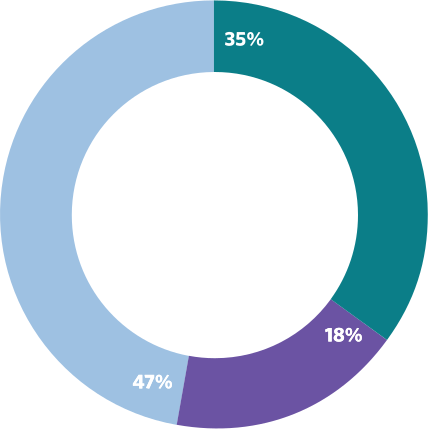
Over a third (35 percent) of New York City homeowners spend over 30 percent of their income on housing, which qualifies them as housing cost burdened.

Eighteen percent (181,000 households) are considered severely cost burdened, spending over 50 percent of their income spent on housing.

wheel chart

GOALS

  • Ensure that homeowners have access to the services they need to remain financially stable: foreclosure prevention, housing counseling, legal services, and tax delinquency assistance.
  • Support and fund more pathways to homeownership for low- and moderate-income families, including community land trusts (CLTs); new construction of affordable condos and coop buildings; and multi-family and enhanced down payment assistance. Ensure these pathways exist at scale.
  • Support and fund community development financial institutions (CDFIs) to bring to market affordable lending products for homeowners that fill gaps left by the traditional banking industry and that cater to underbanked communities.
  • Support first-time homebuyers through down payment assistance, which can help families to compete with all-cash investors amidst a challenging housing market.
  • Reform New York City property taxes and the city's tax lien sale to ensure that no family loses their home due to a small, unpaid bill. Rather, homeowners should have access to affordable payment plans and education and counseling services to help understand their options and manage ongoing expenses.
  • Address the income side of the affordability equation by improving access to good jobs through neighborhood-targeted workforce development, job access strategies, and living-wage policies.
  • Promote strong consumer financial protection regulation and enforcement at the federal and state levels, and ensure that regulation keeps up with technological advances, such as new digital lending platforms.
  • Modernize the Community Reinvestment Act to better ensure that financial institutions help meet the credit needs of all communities, with an emphasis on increasing lending to people of color in historically redlined neighborhoods. Expand the Community Reinvestment Act to cover online lenders as well as brick-and-mortar banks.
  • Ensure that homeowners have access to the services they need to remain financially stable: foreclosure prevention, housing counseling, legal services, and tax delinquency assistance.
  • Support and fund more pathways to homeownership for low- and moderate-income families, including community land trusts (CLTs); new construction of affordable condos and coop buildings; and multi-family and enhanced down payment assistance. Ensure these pathways exist at scale.

4. Aging in Community

VISION

New York City's senior homeowners have the resources they need to avoid scams, stay in their homes, and plan for their futures.

Seniors are among the most vulnerable homeowners in New York City: They are frequently the target of scammers and require additional services to help age in their communities, as well as additional support to protect them from financial shocks. They are also more diverse and much more likely to be immigrants than seniors in other parts of the country; many live in multi-generational households. Affordable estate planning is an often overlooked need for families that are "house rich" but "cash poor," but is essential to help families preserve and transfer wealth over generations, particularly for black and Latinx families. Foreclosures following reverse mortgage defaults are another major concern, as is financial abuse and deed theft scams.
Senior homeowners over the age of 65 increased by 73,000 (29 percent) between 2008 and 2017, while the number of non-senior homeowners decreased by 87,000 (11 percent) over the same period.

GOALS

  • Provide estate planning resources so that seniors and their families can plan for the future and keep their homes in their families.
  • Expand affordable financing resources for home repairs and accessibility retrofits and assist homeowners with contracting.
  • Increase protections from financial abuse and scams by investing in community outreach and education for seniors, their families, and their neighbors. Toughen laws, require LLC transparency, increase enforcement, and ensure legal services resources to better assist victims of scams.
  • Partner with health care providers, social workers, and other senior service providers to develop cross-referrals for senior homeowners in need of housing, medical, or other supports.
  • Increase outreach, education, and assistance for seniors struggling with property tax and water delinquencies.
  • Support reverse mortgage borrowers and develop safer lending products. As more homeowners become seniors, we can expect increased numbers of reverse mortgage borrowers and reverse mortgage defaults. In addition to averting reverse mortgage foreclosure, greater resources are needed to educate borrowers about the risks and their responsibilities.
  • Explore financial assistance models for home repair and use of equity as alternatives to reverse mortgages, which jeopardize housing stability while increasing the racial wealth gap.
  • Develop alternative models and programs for senior homeowners to leverage their home for improved financial stability, such as condo/coop conversions and homesharing.
  • Ensure that seniors who wish to exit homeownership have access to affordable rental housing in their neighborhood, including Section 202 affordable housing with supportive services for seniors.
  • Provide estate planning resources so that seniors and their families can plan for the future and keep their homes in their families.
  • Expand affordable financing resources for home repairs and accessibility retrofits and assist homeowners with contracting.

5. Climate Justice

VISION

New York City homes and the people who live in them are prepared for climate change and to fight back by reducing CO2 emissions by making their homes greener and more energy-efficient.

Hurricane Sandy caused unprecedented damage in New York City, but climate change will likely make such storms all too common in our city's future. In addition to threatening New Yorkers' physical safety through more frequent and intense flooding and heat emergencies, climate change will pose affordability challenges, such as higher flood insurance premiums and recovery from more frequent disasters. While we are deeply vulnerable to climate change, we are not powerless: New York homeowners and their tenants can contribute to the fight against climate change by adopting measures to reduce carbon emissions. These efforts should be undertaken using a climate justice lens, addressing the disproportionate impact of climate change on low- and moderate-income New Yorkers and communities of color. Disaster preparedness and climate resilience should be accessible to all New Yorkers, regardless of race, ethnicity, income or background.
When FEMA's new flood maps are adopted, the number of New Yorkers living in a high-risk flood zone will likely double to about 400,000, greater than the populations of New Orleans, Cleveland, or Honolulu.
waves

GOALS

  • Provide flood resiliency education and make flooding resiliency retrofits affordable for homeowners so that they can reduce the risk of flooding as well as the cost of flood insurance.
  • Provide greater energy efficiency resources for homeowners. We need a program that can rapidly upgrade New York City's 1-4 family housing stock applying a single package of retrofits to older homes, such as air sealing, weatherstripping, attic and roof insulation, and common health and safety fixes. These resources should take advantage of existing weatherization programs.
  • Ensure safe, affordable financing for green home upgrades such as solar panel installation, energy-efficient heating and cooling systems, green roofs and yards, and similar measures.
  • Ensure the involvement of community members and organizations in disaster response planning and recovery efforts, giving particular attention to the linguistic and cultural needs of community members. Planning should be a continuous process, so that communities are prepared before disaster strikes.
  • Provide flood resiliency education and make flooding resiliency retrofits affordable for homeowners so that they can reduce the risk of flooding as well as the cost of flood insurance.
  • Provide greater energy efficiency resources for homeowners. We need a program that can rapidly upgrade New York City's 1-4 family housing stock applying a single package of retrofits to older homes, such as air sealing, weatherstripping, attic and roof insulation, and common health and safety fixes. These resources should take advantage of existing weatherization programs.

CONTACT

Comments? Feedback?

Email us at blueprint@cnycn.org.

SIGN UP

ABOUT

The mission of the Center for NYC Neighborhoods is to promote and protect affordable homeownership in New York so that middle- and working-class families can build strong, thriving communities.

The Center was created by leaders from city government, philanthropy, nonprofits and finance in response to the urgency of the nation's housing crisis more than a decade ago. In the years since, the Center has evolved to take on a number of challenges that have threatened to destabilize working class families, from helping homeowners recover from climate crises and extreme weather to the challenge of affordability that confronts the city today.

This blueprint draws on our expertise working with homeowners, partners, and community and government leaders; it is informed by a decade of research and investigation. It cements our commitment to our city, its communities, and its people.

We'd like to thank the key partners who took time to review and provide feedback on this visionary document. The Equitable Homeownership Blueprint was made possible with the support of Citi Community Development.

For more information on our services and work, go to cnycn.org.

Contact UsContractingTerms & ConditionsPrivacy Policy